Designing Effective Challenges
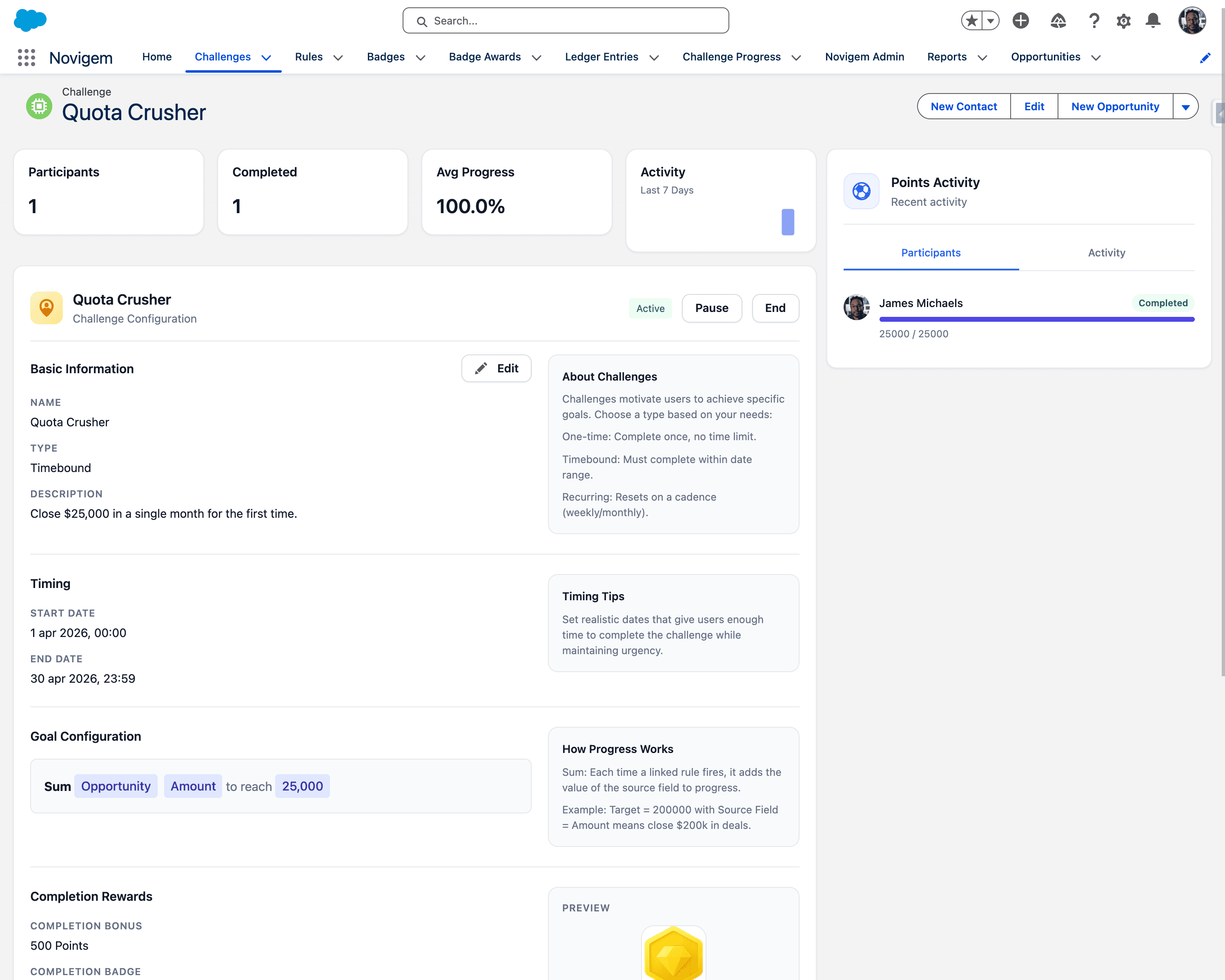
Well-designed challenges are the foundation of a successful Novigem program. They determine which behaviors are reinforced, how fair the system feels, and whether participation remains high over time.
Reinforce concrete actions
Not just abstract results. Anchor to real Salesforce behaviors.
Keep rules simple
1 to 3 rules per challenge. Easy to understand at a glance.
Transparent and predictable
The system must be fair and non-abusable for trust to hold.
Short seasons
2 to 4 weeks keeps energy high and resets competition regularly.
Overview
This playbook outlines practical guidelines for designing challenges that drive meaningful Salesforce behavior without creating noise or unintended outcomes.
If you are new to Novigem, we recommend reading the Challenges Core Concept page first for a technical overview, or following the Create your first challenge tutorial for a step-by-step setup.
Start With the Behavior, Not the Metric
Effective challenges begin with a clear definition of the behavior you want to reinforce.
Instead of focusing on abstract metrics, anchor challenges to concrete Salesforce actions, such as:
- Creating or updating specific records
- Completing defined fields
- Performing actions within a time window
If a behavior cannot be clearly observed in Salesforce, it is difficult to reinforce consistently.
Keep Challenges Simple and Specific
Challenges should be easy to understand at a glance.
Good challenges typically:
- Measure one primary behavior
- Have clear start and end conditions
- Avoid complex combinations of Rules in a single challenge
If a challenge requires extensive explanation, it usually needs to be split into multiple simpler challenges.
Align Challenge Types With the Behavior
Different behaviors benefit from different challenge structures.
Common patterns include:
- One-time challenges for onboarding or new process adoption
- Recurring challenges for ongoing habits such as activity logging
- Streak-based challenges for consistency over time, using the native daily and weekly streaks with optional milestone bonus points
- Time-boxed challenges for short-term focus or campaigns, where goal pace tells each rep whether they are ahead, on track, or behind
Choosing the right structure helps reinforce the behavior without fatigue.
Use Points to Reinforce, Not Distort
Points should reflect the relative importance of a behavior, not its volume.
Guidelines for point design:
- Assign higher points to behaviors that require more effort or judgment
- Avoid extreme point gaps that overshadow other challenges
- Keep point values stable to maintain trust
Points are most effective when they encourage balance rather than gaming.
Design for Fairness and Trust
Participants must believe the system is fair.
To support trust:
- Validate that actions represent meaningful changes
- Prevent duplicate point awards for the same outcome
- Ensure challenges apply consistently across similar roles
Anti-gaming protections are as important as motivation.
Balance Individual and Team Challenges
Individual challenges encourage accountability, while team challenges encourage collaboration.
A healthy program often includes:
- Individual challenges tied to personal execution
- Team challenges tied to shared outcomes or consistency
Avoid mixing fundamentally different roles in the same leaderboard unless the behavior applies equally.
Use Seasons to Reset Momentum
Time-based seasons help keep engagement fresh.
Seasons allow teams to:
- Reset leaderboards regularly
- Give new participants a fair starting point
- Review past performance without permanent ranking
Shorter seasons are generally more effective than open-ended competition.
Reinforce With Feedback, Not Noise
Feedback should support action, not distract from it.
Effective programs:
- Use leaderboards so reps can see their progress at a glance
- Let the coaching feed surface the next best action, so reps get one specific prompt instead of a wall of stats
- Use goal pace on time-boxed challenges so “behind” is visible while there is still time to act, not at the end
- Keep point values consistent so the system feels predictable
- Celebrate challenge completions with badges to mark milestones
Well-designed feedback builds habits without creating fatigue.
Review and Adjust After Each Cycle
No challenge design is perfect on the first attempt.
After each cycle, open Challenge Impact in Novigem Admin. It compares participants’ tracked activity before, during, and after the challenge, so you can read two things directly:
- Activity Lift: did the behaviour actually increase during the challenge
- Retention: did the increase hold once the challenge ended
A challenge with strong lift and no retention is a challenge worth repeating, not a habit you have built.
Pair that with what the numbers do not show:
- Participation rates
- Drop-off points
- Evidence of unintended behavior
Small adjustments to rules, timing, or points often have a large impact on outcomes.
Let Novigem Suggest the Next One
When most of the team earns points from a behaviour that some reps never touch, Novigem proposes a two-week challenge to close that gap. One click creates it.
Treat suggestions as a starting point, not a finished design. The principles above still apply: check the rule is one clear behaviour, the timeframe suits the habit, and the point value fits alongside your existing challenges. Creating suggested challenges needs Novigem Admin.
Outcome
Effective challenges make expectations clear, reinforce the right behaviors, and build trust over time.
When challenges are designed thoughtfully, Novigem becomes a system that supports consistent execution, directly inside Salesforce.
These principles apply to every playbook in this section. If a challenge design does not follow them, it is worth revisiting before going live.
Related
- Improve Opportunity Stage Hygiene: Improve forecast accuracy and CRM data hygiene.
- Drive More First Meetings: Increase pipeline volume and early-stage activity.
- Drive Account Expansion: Grow existing accounts and improve upsell rates.
- Playbooks Overview: A complete list of role-based blueprints.
- Challenges Overview: Learn how challenges act as containers for behavior change.